Staking Protocols











Validator Insurance
Discover how High Stakes protects delegators against slashing penalties.



Infrastructure


Enterprise RPC & Infrastructure
Get dedicated blockchain connectivity for Enterprise Needs

Staking Protocols

Validator Insurance
Discover how High Stakes protects delegators against slashing penalties.
Infrastructure
Enterprise RPC & Infrastructure
Get dedicated blockchain connectivity for Enterprise Needs
Staking Protocols
Validator Insurance
Discover how High Stakes protects delegators against slashing penalties.
Infrastructure
Enterprise RPC & Infrastructure
Get dedicated blockchain connectivity for Enterprise Needs
Cosmos Network
Infrastructure
Pocket Network: rebuilding the Internet’s data highways
Pocket Network: rebuilding the Internet’s data highways
Pocket Network: rebuilding the Internet’s data highways

•
Feb 28, 2026
In today’s digital economy, applications depend on APIs the way cities depend on electricity. When those APIs fail, entire ecosystems go dark.
In Web3, that risk is even greater. Blockchains like Ethereum or Solana may be decentralized at the consensus layer, but access to their data often isn’t. Most applications rely on centralized RPC providers to read and write blockchain data. If those providers go offline, change pricing, throttle usage or face regulatory pressure, thousands of applications can be affected overnight.
Pocket Network exists to eliminate that single point of failure.
While blockchain consensus is decentralized, the API layer is often controlled by a handful of infrastructure companies. This creates operational fragility, vendor lock-in, pricing power concentrated in few hands, regulatory and censorship exposure, barriers to innovation for new developers. For investors, this represents a structural weakness in the Web3 stack.
A crypto-native API layer
Pocket Network is a decentralized protocol that coordinates thousands of independent nodes to serve blockchain data reliably and permissionlessly. Instead of routing requests through a single provider, Pocket distributes them across a global network of node operators.
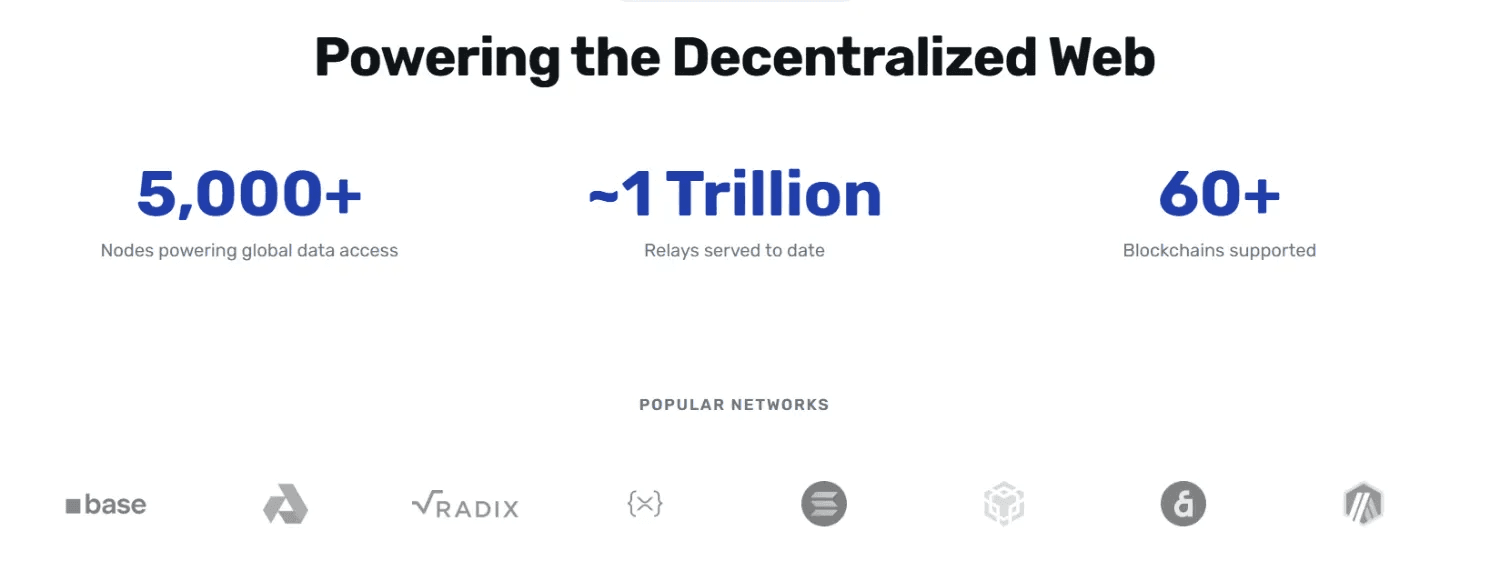
Pocket turns public blockchain data into a public utility:
60+ supported blockchains
No API key required for public endpoints
Decentralized load balancing
Built-in economic incentives for uptime and performance
Pocket operates through two main components:
1. A permissionless API registry: anyone can list an API for a public dataset or blockchain.
2. Incentivized node operators: independent operators run infrastructure and are rewarded for reliability, performance, availability. Poor performance is penalized. High performance is rewarded.
This economic coordination replaces reliance on a single corporate intermediary.
Why this matters?
1️⃣ Infrastructure is the Picks-and-Shovels layer.
In every technology cycle, the most durable value is often created at the infrastructure level. Just as cloud providers like AWS, Azure, and Google Cloud became foundational to the internet economy, Web3 infrastructure underpins decentralized finance, gaming, AI agents, and tokenized assets.
No matter which applications win, they all require reliable blockchain data access. When blockchain usage grows, the need for stable, high-performance RPC access grows with it. Pocket is positioned at this critical access layer, a structural bottleneck that every Web3 application depends on.
2️⃣ Non-profit model = structural cost advantage
The Pocket Network Foundation operates as a non-profit with a mandate to provide open access to public data. This structure enables very low operating margins, wholesale-level pricing, alignment with open-data principles, long-term competitive pricing pressure on centralized providers.
While traditional RPC providers must optimize for shareholder margins, Pocket optimizes for network sustainability and accessibility. That difference can translate into meaningful pricing resilience and long-term competitiveness.
3️⃣ A structural moat through decentralized coordination
Pocket’s advantage is not brand recognition, it’s network architecture. Its model is built on independent node operators, incentive mechanisms rewarding uptime and performance, decentralized load balancing across gateways, a growing base of infrastructure participants.
As demand increases, more operators are incentivized to join, strengthening redundancy and reliability. Instead of concentrating power in a single provider, growth reinforces decentralization creating a coordination-based moat that is difficult to replicate.
4️⃣ Exposure to the entire multi-chain ecosystem
Pocket supports more than 60 blockchains. This means it benefits from growth in the Ethereum ecosystem, expansion of Layer 2 networks, adoption of emerging chains, new application verticals across Web3.
Rather than betting on one chain, Pocket represents exposure to the entire blockchain access layer.
Pocket Network and the rise of “User-owned data”
One of the most exciting trends in Web3 today is something called DePIN for Data, a term that sounds technical, but really describes a simple idea: instead of relying on a single company to provide access to data, networks can be built so that users themselves collectively own and maintain the infrastructure that delivers that data. This shift changes everything about how applications access blockchain, mapping, AI and public datasets.
When an application needs blockchain data (whether it’s a wallet checking balances, a DeFi app reading contract states, or a developer analyzing token transfers), the request doesn’t go to a single server owned by a company. Instead, it travels through a distributed network of independent node operators around the world. These nodes are constantly verified and rewarded for delivering accurate and timely responses. In other words, each node competes to provide high-quality service, and if a node underperforms, the network automatically routes requests elsewhere.
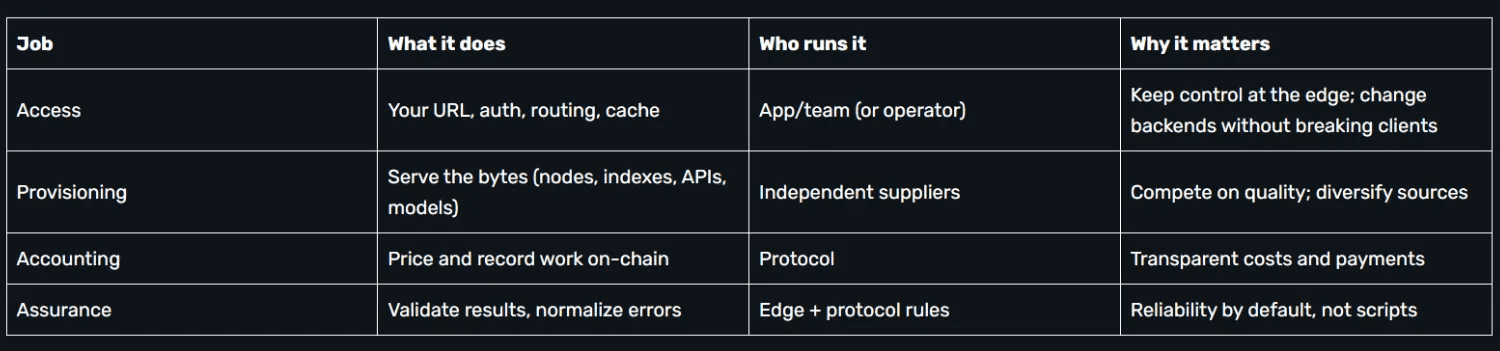
This system brings multiple advantages:
It makes access extremely reliable: applications no longer depend on a single provider that could go offline, increase pricing, or censor traffic.
It creates transparency: costs, performance and usage are measurable and verifiable on-chain, so developers and companies know exactly what they are paying for.
It shifts control to the user: teams or individuals running their own gateways can manage traffic, switch backend nodes as needed, and maintain uninterrupted access without touching client code.
So, Pocket doesn’t just provide decentralized access to blockchain data, it embodies a broader movement toward “user-owned data highways.” By giving participants both ownership and economic incentives, Pocket aligns the network’s growth with real-world usage and ensures that the infrastructure powering Web3 is resilient, scalable and fair. For investors, this is important: the network isn’t just a service but it’s a self-reinforcing ecosystem where demand and participation create sustainable value, while reducing risk tied to centralized providers.
Why $POKT tokenomics make Pocket Network unique?
At its core, $POKT transforms how blockchain networks reward activity and sustain value. Unlike traditional token models where increased usage inflates supply and dilutes value, Pocket Network flips the equation: more activity reduces supply.
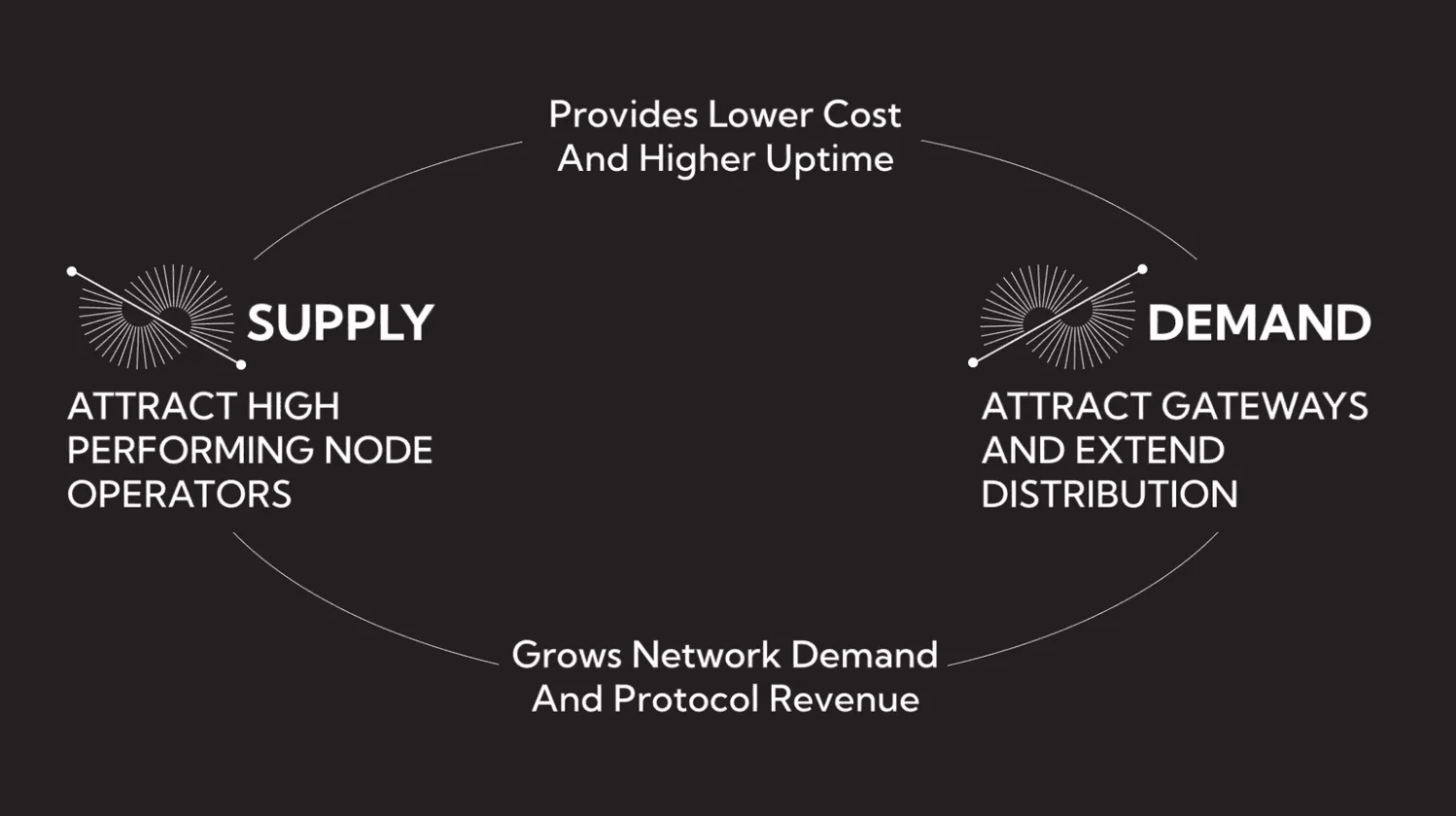
Every time an application sends a request through a gateway, $POKT is burned to pay for that relay. Node operators and sequencers are then rewarded from freshly minted $POKT, creating a transparent, real-time loop where costs and rewards mirror actual work.
Deflationary by design
With the PIP-41 deflation module activated, each transaction now slightly reduces net supply, meaning the more the network is used, the more scarce $POKT becomes. This aligns token economics directly with adoption, turning usage into value creation rather than dilution.
Balanced Burn-Mint dynamics
The Shannon upgrade assured that $POKT is only ever minted as a result of a burn payment for work being done, enforcing a zero inflation economy, which is then further reduced by the deflationary mechanisms. This creates sound business fundamentals with stable rewards and predictable deflation, giving confidence to both infrastructure providers and investors in long-term network stability.
Usage-driven value
Unlike traditional networks where tokens are “printed” regardless of demand, $POKT’s value grows with real-world activity. High relay volumes directly drive burn, increasing scarcity and supporting token price, while rewarding operators fairly.
Scalable deflation mechanics
Burn ratios are configurable, meaning the network can respond to periods of high demand by burning proportionally more than is minted. The result is a self-regulating, sustainable ecosystem where growth strengthens token value rather than diluting it.
Pocket Network isn’t just another blockchain project; it’s a living, demand-driven economic system where tokenomics and infrastructure work hand-in-hand to create durable value.
If you are looking for acquiring $POKT, all official links and purchasing information are available here.
—————
Please note that this article is for informational purposes only and does not constitute financial, investment or trading advice. Digital assets are volatile and carry risk. Always conduct your own research before making any investment decisions.

Interested in Staking with Us?
Join 30,000+ other stakers earning optimized rewards with our high-performance validators.
Get started and maximize your staking potential.