Staking Protocols











Validator Insurance
Discover how High Stakes protects delegators against slashing penalties.



Infrastructure



Enterprise RPC & Infrastructure
Get dedicated blockchain connectivity for Enterprise Needs

Staking Protocols

Validator Insurance
Discover how High Stakes protects delegators against slashing penalties.
Infrastructure
Enterprise RPC & Infrastructure
Get dedicated blockchain connectivity for Enterprise Needs
Staking Protocols
Validator Insurance
Discover how High Stakes protects delegators against slashing penalties.
Infrastructure
Enterprise RPC & Infrastructure
Get dedicated blockchain connectivity for Enterprise Needs
Cosmos Network
Cosmos at a crossroads: understanding COSMOSIS
Cosmos at a crossroads: understanding COSMOSIS
Cosmos at a crossroads: understanding COSMOSIS
A summary of the Cosmos-Osmosis merger proposal, summarizing the project, its stakes and the arguments for and against.

•
Mar 17, 2026
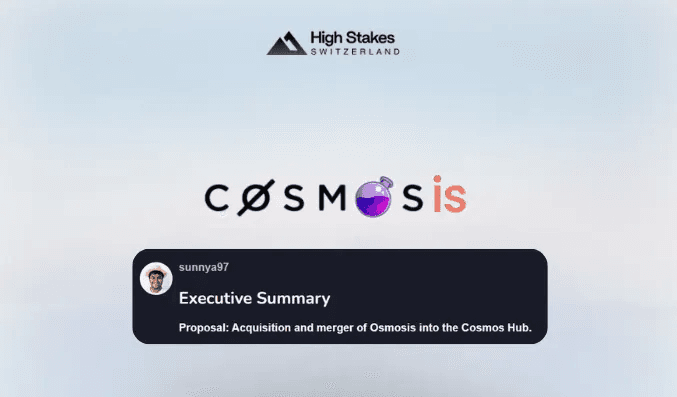
There are proposals that tweak parameters. There are proposals that allocate funds. And then there are proposals that, if passed, fundamentally reshape what a blockchain is. The COSMOSIS proposal, published on March 11, 2026, belongs firmly in that third category.
Written by Sunny Aggarwal, one of the original founders of the Osmosis DEX, it puts forward a bold idea: that Osmosis, the dominant decentralized exchange of the Cosmos ecosystem, should be acquired by and merged into the Cosmos Hub.
If it passes, the Cosmos Hub would no longer just be a coordination and security layer. It would become a full-stack financial platform: a home for liquidity, trading, asset issuance and interoperability. All governed by a single token, ATOM.
Why does this exist?
To understand COSMOSIS, you need to understand the current state of the Cosmos ecosystem. Cosmos was built on a foundational idea: blockchains should be sovereign. Rather than forcing all applications onto a single chain, developers should be free to launch their own chains, each with its own rules, token, and governance, all connected through the Inter-Blockchain Communication protocol (IBC).
This worked. The ecosystem exploded. Osmosis launched in 2021 and became the primary place to trade Cosmos-native assets. Other chains flourished: Noble, Mars Protocol, Axelar, Milkyway and many more.
But “flourishing” turned out to be complicated. Over the past year, several of those projects have slowed down, pivoted or wound down entirely. Noble repositioned. Mars Protocol initiated wind-down procedures. Axelar shifted its roadmap. The fragmentation that was supposed to be a feature started to look, in some lights, like a liability.
Meanwhile, the Cosmos Hub, ATOM’s home chain, has struggled with a persistent question: if the ecosystem grows, how does ATOM benefit? Today, there’s no clear, legible answer. Chains built on the Cosmos stack don’t automatically flow value back to ATOM. COSMOSIS is a direct attempt to solve that. The logic goes: instead of hoping that ecosystem growth eventually trickles back to ATOM, bring the primary liquidity engine inside the Hub. Make the revenue direct. Make the alignment explicit.
What is actually being proposed?
At its core, the proposal has three interlocking parts:
A token swap: OSMO becomes ATOM.
Every OSMO holder would have a six-month window to convert their OSMO into ATOM at a fixed rate: 1.998 OSMO per 0.0355 ATOM. That rate is derived from the 30-day time-weighted average price (TWAP) of the ATOM/OSMO pair on March 11, 2026, the day the proposal was published.
At maximum participation (meaning every eligible OSMO holder converts) the Cosmos Hub would need approximately 11.82 million ATOM to complete the exchange.
Here’s the financial sleight of hand the proposal leans on: the Cosmos Hub’s Community Pool already holds around 10.11 million ATOM. That covers roughly 85% of the cost. The remaining ~1.75 million ATOM would be minted once, as part of the same chain upgrade that integrates the DEX modules. Any ATOM that goes unclaimed after the six-month window returns to the Community Pool.
The DEX moves to the Hub
This is the technical heart of the proposal. Osmosis is not just a brand, it’s a suite of battle-tested software modules that handle everything from pool creation and liquidity management to automated arbitrage and fee capture. Once deployed, the Osmosis frontend would be repointed to the Cosmos Hub. Users would not be migrated automatically. Instead, a guided frontend wizard would walk them through three steps: transfer assets from Osmosis to the Hub, withdraw and redeploy liquidity positions and (optionally) convert OSMO to ATOM.
Operations transfer to the Osmosis Grants Program
The Osmosis Grants Program (OGP), currently the entity that funds ecosystem development around Osmosis, would be re-mandated under Cosmos Hub governance. It would inherit the Osmosis IP, the frontend, and approximately $5 million in non-OSMO assets from the Osmosis Community Pool, on top of its existing ~$1.2 million in holdings.
The OGP estimates this gives it enough runway to fund maintenance and development for at least six years. Critically, Hub governance would retain the ability to claw back these assets at any time through an on-chain vote.
What’s the strategic case?
The proposal makes several arguments for why this is good for ATOM holders:
Revenue clarity
In 2025, Osmosis generated approximately $5.5 million in trading fees, against projected maintenance costs of around $550,000 per year. By integrating Osmosis, the Cosmos Hub gains a clear, attributable revenue stream, something it currently lacks entirely.
Liquidity scales with capital, not just users
The proposal notes that as Cosmos pursues enterprise and institutional adoption (a stated strategic priority for Cosmos Labs), what matters most is not transaction volume from retail users but capital flows from institutions. A DEX’s fee revenue scales with the size of the capital it handles, making it an especially compelling asset in an institutional context.
Consolidation reduces overhead
Today, Osmosis and the Cosmos Hub both require validator infrastructure, separate governance and separate security budgets. Cosmos Hub validators already represent about 66% of voting power on Osmosis. Merging the two eliminates redundant security layers and concentrates capital efficiency.
The Hub becomes a full-stack platform
With permissionless CosmWasm already enabled (Proposal 1007), a token factory in place (Proposal 1010) and Stargaze already migrating to the Hub (Proposal 1017), COSMOSIS would complete a picture: a single chain where you can issue assets, trade them, and route them across the interchain through IBC Eureka.
Where does the community stand?
Cosmos Labs makes its position clear
The reaction has been genuinely mixed, which is itself revealing. Notably, the most significant pushback came from Cosmos Labs itself. It is publicly stated that they do not support the proposal as written. Their core argument: Osmosis is not a profitable acquisition at $22 million with no downside protection. Osmosis revenue is in decline, there is no clear path for a migration to reverse that trend and the proposal as structured would allow founders and team members to exit with liquid ATOM immediately while leaving the long-term and short-term migration risks entirely with the Hub.
Cosmos Labs was careful to note they are not blocking the proposal and have no formal veto. If governance approves it, they intend to support the migration as best they can. But they believe it is not in the Hub’s best interest at $22 million with no downside protection.
A revenue figure that raises more questions than it answers
The proposal’s central financial argument is that Osmosis generated $5.5M in revenue in 2025 against ~$550K in maintenance costs — a compelling margin. But this figure is contested : if 2025 was Osmosis’s peak rather than its floor, the acquisition math looks very different. The community’s ask is straightforward: provide a forward-looking financial model, not just last year’s number. What does the revenue range look like over the next three to five years, in both optimistic and conservative scenarios, under Hub governance? Without that, ATOM holders are being asked to commit $22M on the basis of a single data point with no downside scenario modeled.
No lockup, no milestones, no accountability mechanism
One of the sharpest structural criticisms is what the proposal simply doesn’t include: any mechanism ensuring the Osmosis team remains accountable after the conversion. As currently written, nothing prevents core team members from converting their OSMO to ATOM immediately and walking away. There are no vesting schedules, no milestone-based disbursements, and no performance requirements tied to migration success. This stands in notable contrast to the Stargaze migration proposal (a much smaller transaction at ~$1.5M) which was structured around milestone-based funding and quarterly oversight.
The Community Pool is a finite resource
The proposal leans on a reassuring framing: 85% of the required ATOM is “already there” in the Community Pool, making the deal largely self-financing. This is accurate, but it obscures a real opportunity cost. That pool took years to accumulate and represents the Hub’s reserve for future grants, development funding, ecosystem support and unforeseen needs. Committing the vast majority of it in a single transaction leaves the Hub with almost no financial flexibility for the years ahead.
Revenue alignment, not operational control
Perhaps the most structurally interesting critique isn’t about the price at all; it’s about whether a full merger is actually the right architecture for what the Hub needs. Several community members have proposed an alternative path that achieves most of the same goals without eliminating Osmosis’s sovereignty: make ATOM the primary fee settlement currency on Osmosis, establish IBC-based revenue sharing so the Hub captures a share of DEX fees directly, align validator sets through shared security mechanisms rather than full merger.
This approach would give ATOM holders real economic exposure to Osmosis without eliminating the chain’s ability to move fast, experiment and operate independently. The argument is that the Hub needs revenue alignment, not operational control. Those are different things, and the proposal conflates them in ways that may create more complexity than they resolve.
——————————————
COSMOSIS is not just an internal governance debate. It raises questions that will matter across the broader blockchain space. When does sovereign experimentation end and strategic consolidation begin?
The Cosmos ethos always assumed that sovereign chains were a permanent architecture, not a transitional one. COSMOSIS challenges that assumption directly, and there is a real cost (financial, cultural and philosophical) to abandoning the sovereignty model that defined Cosmos from the beginning.
The proposal is in its feedback phase. It has not gone to an on-chain vote. It may be refined, restructured or abandoned based on community response. It may pass overwhelmingly. It may fail quietly. The discussion is active and ongoing here.

Interested in Staking with Us?
Join 30,000+ other stakers earning optimized rewards with our high-performance validators.
Get started and maximize your staking potential.