Staking Protocols











Validator Insurance
Discover how High Stakes protects delegators against slashing penalties.



Infrastructure



Enterprise RPC & Infrastructure
Get dedicated blockchain connectivity for Enterprise Needs

Staking Protocols

Validator Insurance
Discover how High Stakes protects delegators against slashing penalties.
Infrastructure
Enterprise RPC & Infrastructure
Get dedicated blockchain connectivity for Enterprise Needs
Staking Protocols
Validator Insurance
Discover how High Stakes protects delegators against slashing penalties.
Infrastructure
Enterprise RPC & Infrastructure
Get dedicated blockchain connectivity for Enterprise Needs
Cosmos Network
Infrastructure
Axone: unlocking collective intelligence
Axone: unlocking collective intelligence
Axone: unlocking collective intelligence

•
Jan 19, 2026
Artificial Intelligence is no longer a technical experiment, it is a strategic asset. Yet today’s AI landscape has the same problems as a closed financial system where assets are locked in separate institutions, transactions are costly and collaboration is limited. Data is locked inside organizations, computing power is concentrated in the hands of a few players and AI models operate in isolation. Instead of accelerating innovation, this fragmentation increases costs, slows execution and limits who can truly compete. Just as modern enterprises had to break down internal silos to scale efficiently, AI now requires a new model — one built on coordination, trust and collaboration.
Axone Protocol proposes a fundamentally different approach. Rather than treating AI as a collection of isolated assets owned and operated by a few players, Axone introduces a collaborative intelligence layer: a decentralized infrastructure where data, models, compute and algorithms can be shared, governed and monetized with the same rigor and transparency as modern financial systems.
Axone comes as the connective tissue of AI collaboration, similar to how financial markets connect capital or ERP systems connect people, processes and resources inside enterprises.
Axone’s ambition is simple but transformative: turn fragmented AI resources into a shared, trusted and economically aligned ecosystem — unlocking innovation that no single organization could achieve alone.
The hidden cost of centralized intelligence
AI today resembles a closed financial system. In traditional finance, closed markets lead to inefficiency, lack of liquidity and high barriers to entry. AI today suffers from the same structural problem. A small number of organizations control the largest datasets (data monopolies), the most advanced models (intellectual property moats), the majority of compute power (capital-intensive infrastructure).
Just as capital concentration limits economic dynamism, AI centralization limits innovation. Training a state-of-the-art AI model today can cost tens or hundreds of millions of dollars — comparable to building a power plant or acquiring a multinational company. This makes cutting-edge AI inaccessible to most startups, research institutions and even large enterprises outside Big Tech.
Even the largest AI companies struggle with GPU shortages, energy constraints and infrastructure bottlenecks. From a business perspective, this is equivalent to having capital trapped in illiquid assets — unable to flow to the most productive opportunities. When resources are siloed and collaboration is costly, organizations default to competition over cooperation. We already see the consequences: fewer shared research breakthroughs, reduced transparency, slower collective progress.

Axone Protocol enters at this exact point of friction — not to replace companies, platforms or existing AI systems, but to connect them, much like financial infrastructure connects banks, markets and institutions while preserving sovereignty and competition.
Axone: the orchestration infrastructure for AI collaboration
In traditional business, value creation has shifted over time:
From owning factories → to orchestrating supply chains
From holding capital → to managing liquidity and risk
From vertical integration → to platform-based ecosystems
AI is undergoing the same transformation. Owning data, models or compute is no longer enough. The real competitive advantage lies in how efficiently these resources can be combined, governed and monetized across organizational boundaries. Axone acts as the infrastructure layer that makes this possible, orchestrating the resources, services, agents and workflows to leverage the models and data as efficiently as possible.
In global business, contracts, accounting standards and legal frameworks enable companies to work together — even if they operate in different countries and industries. AI lacks this shared language. Axone introduces an on-chain semantic ontology, which functions like a universal balance sheet for digital resources. Data, models, algorithms, APIs and compute are described in a standardized, machine-readable way. This allows both humans and AI agents to:
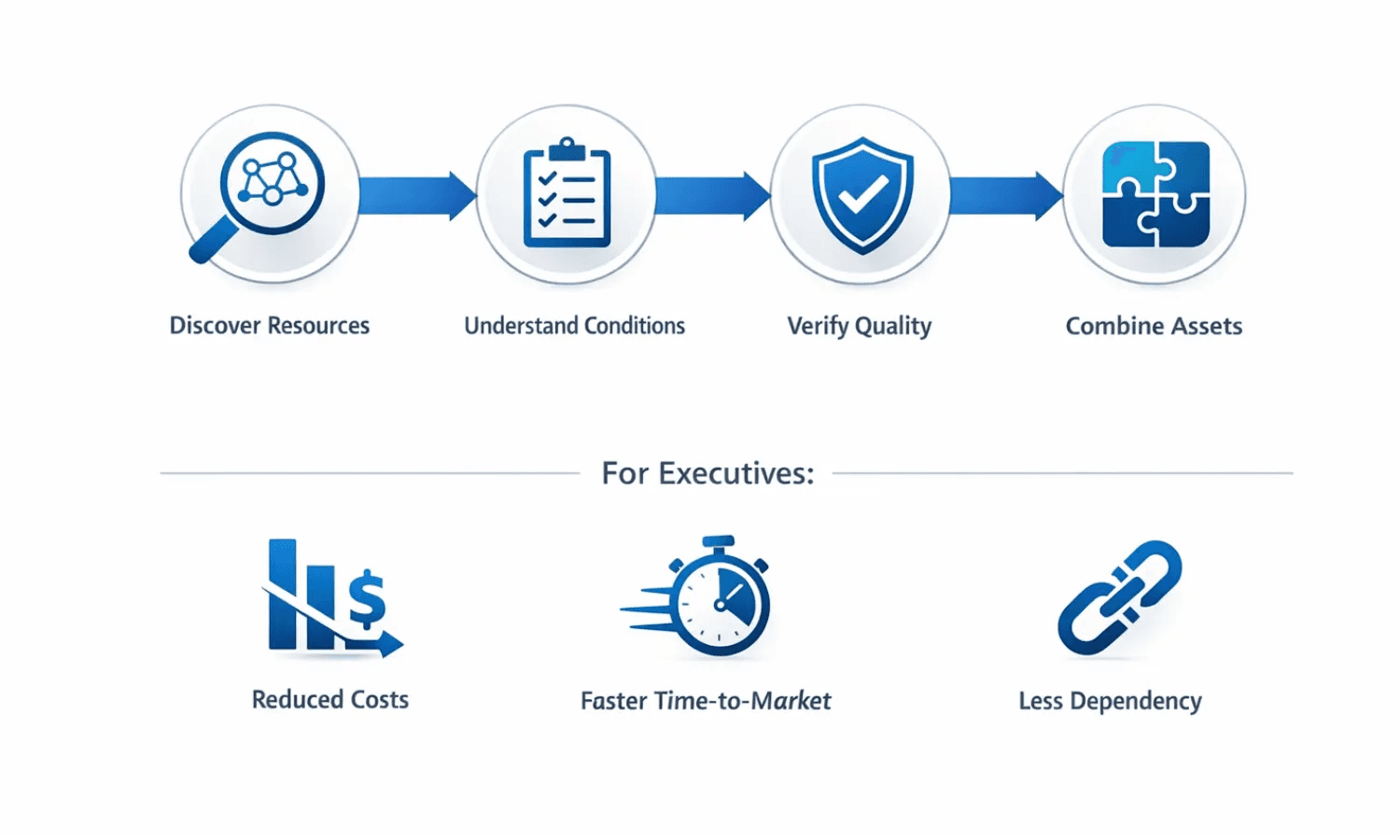
In finance, we rely on audits, certifications and compliance frameworks to ensure that assets are real, reliable and legally sound. Axone applies the same logic to AI through Verifiable Credentials. Every resource on Axone can carry cryptographically verifiable attributes: who owns it, how it was produced, under what conditions it can be used, what compliance rules apply.
Instead of relying on a single platform, cloud provider or intermediary, organizations can collaborate with confidence — knowing that rules are enforced automatically and transparently.
Governance as a strategic lever, not a constraint
Governance is not about restriction — it is about alignment. Well-designed governance aligns incentives, reduces risk, enables scale.
Axone introduces a zone-based governance model, comparable to how multinational corporations operate across subsidiaries, business units or regulated markets.
Each Axone “zone” can define:
its own rules,
access rights,
economic models,
compliance constraints.
As a result, different actors can operate in environments designed for their needs: enterprises can run private or consortium spaces, startups can experiment in open innovation zones, and industry groups can build AI infrastructure together. Crucially, these zones remain interoperable — just as different markets, subsidiaries or jurisdictions can still trade with each other under common standards.
One of Axone’s key innovations is its declarative governance model. In simple business terms, this means moving from manual, fragmented compliance processes to programmable corporate policies. Instead of hard-coding rules into complex systems, governance is expressed as clear business logic: who can access which resources, under what conditions, and how value is shared.
Once these rules are defined, they are automatically enforced across the system. They can be monitored in real time, audited at any moment and adjusted without rebuilding entire infrastructures. For executives, the impact is straightforward: lower operational complexity, stronger trust, and greater accountability — all essential when deploying AI at scale.
Axone's governance zones are fully programable and declarative, making them significantly more customizable and powerful than a DAO.
The token model: aligning incentives, not speculation.
At its core, the $AXONE token is designed to support real economic activity, not financial speculation. It functions as the common unit that aligns incentives across the ecosystem — much like a shared currency aligns participants in a market.
$AXONE will be used to access resources, pay for AI workflows, reward contributors and participate in governance decisions. When value is created — through data usage, model execution or collaborative workflows — it flows automatically to those who contributed. At the same time, zones can require staking to ensure commitment and quality, similar to financial guarantees or performance bonds in traditional business relationships. As more workflows are orchestrated and more collaboration happens across zones, economic activity increases. This creates a clear and understandable model: the more Axone is used, the more value it generates for its ecosystem.
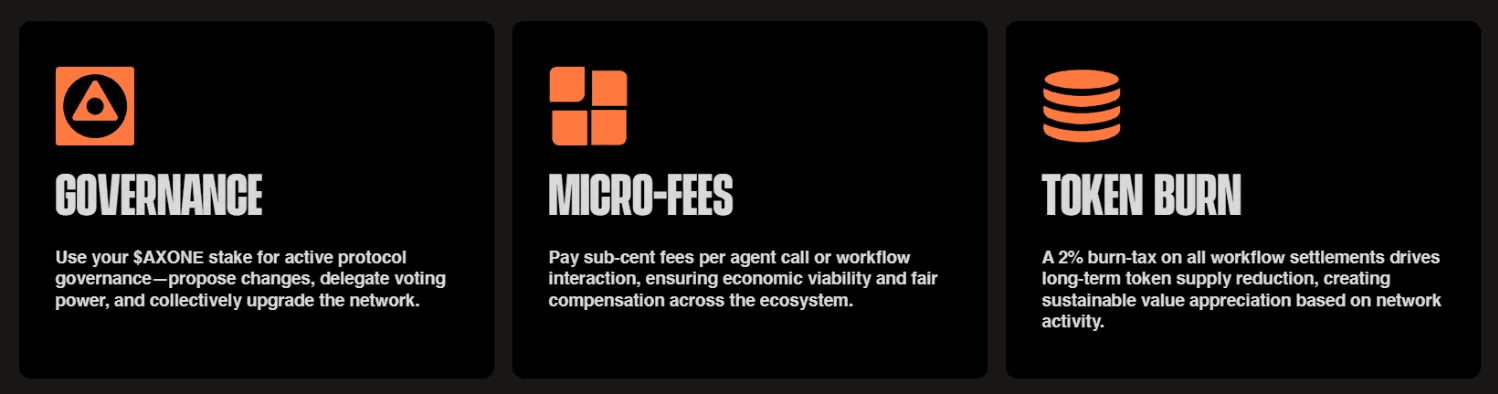
One of the most practical advantages of the $AXONE token is its ability to make very small transactions economically viable. In traditional AI systems, charging for small actions — such as a short burst of compute, a single model inference, or limited access to a dataset — is often too complex or costly to manage. Axone removes this friction by enabling sub-cent payments natively within the protocol.
This works much like the evolution of digital payments in finance. Just as low-cost transactions unlocked new business models in e-commerce and high-frequency trading improved market liquidity, micro-transactions unlock entirely new ways for AI resources to be shared and monetized. Every interaction can be priced fairly, based on actual usage rather than flat fees or long-term contracts.
$AXONE listing is planned on decentralized exchanges like Osmosis around mid-2026 alongside the deployment of early applications in healthcare, legal data and Earth observation. Strategic partnerships with Fetch.ai, Akash, Ta-Da, and Zero Gravity will strengthen the ecosystem, paving the way for the Universal Discovery Layer and next-generation AI agents that combine reasoning and learning — all powered by the $AXONE token.
The Axone Governance Forum invites all — validators, future token holders and builders — to participate, share ideas and help shape the next direction of the protocol.
————————————————
Axone is not just another AI platform, it is a coordination layer that enables organizations and AI agents to collaborate, innovate and create value without giving up control or competitive advantage.
Step by step, Axone is building the semantic and economic infrastructure for the agentic web, where billions of participants can discover, transact and collaborate transparently. For executives and innovators alike, Axone represents a strategic shift from isolated intelligence to collaborative intelligence, unlocking long-term value that no single organization could achieve alone.

Interested in Staking with Us?
Join 30,000+ other stakers earning optimized rewards with our high-performance validators.
Get started and maximize your staking potential.