Staking Protocols











Validator Insurance
Discover how High Stakes protects delegators against slashing penalties.



Infrastructure



Enterprise RPC & Infrastructure
Get dedicated blockchain connectivity for Enterprise Needs

Staking Protocols

Validator Insurance
Discover how High Stakes protects delegators against slashing penalties.
Infrastructure
Enterprise RPC & Infrastructure
Get dedicated blockchain connectivity for Enterprise Needs
Staking Protocols
Validator Insurance
Discover how High Stakes protects delegators against slashing penalties.
Infrastructure
Enterprise RPC & Infrastructure
Get dedicated blockchain connectivity for Enterprise Needs
Cosmos Network
Cosmos Hub weighs a $300K bet to get ATOM onto Wall Street’s Books
Cosmos Hub weighs a $300K bet to get ATOM onto Wall Street’s Books
Cosmos Hub weighs a $300K bet to get ATOM onto Wall Street’s Books

•
Sep 14, 2026

A new proposal in front of the Cosmos Hub community is asking a familiar question in a new setting: should the DAO’s community pool pay to open a door that crypto-native exchanges never had — regulated Wall Street brokerages?
Posted on the Cosmos Hub forum on September 1, 2026 by Paxos, the proposal requests a one-time 300,740 USDC spend from the Community Pool to integrate and list ATOM on Paxos’ Enterprise Brokerage and Custody Platform. It has since been updated twice, most recently on September 9 with a new go-live date and additional transparency commitments.
What is Paxos?
Paxos is a regulated infrastructure provider, chartered by the Office of the Comptroller of the Currency (OCC) in the US and licensed as a major payment institution by the Monetary Authority of Singapore (MAS), that sits behind the scenes of major consumer and institutional platforms, handling custody, trading and settlement so those platforms don’t have to build crypto infrastructure themselves.
That “invisible plumbing” model is precisely the point. Paxos already powers crypto features for PayPal, Venmo, Revolut, Mercado Libre, and Interactive Brokers, and it provides the sub-custody and execution infrastructure behind Charles Schwab’s crypto trading service, which reported roughly 39 million active brokerage accounts. Schwab has used that same Paxos rail to add tokens beyond Bitcoin and Ethereum: the brokerage recently announced plans to bring Solana, Avalanche and Chainlink to its platform, all running through Paxos. Interactive Brokers took a similar route in 2023, reportedly launching crypto trading in about six months by outsourcing custody to Paxos rather than building it in-house, a process the firm says can otherwise take two years or more.
The pitch to Cosmos Hub, in other words, is: pay once for the plumbing, and any brokerage on Paxos’ network becomes able to add ATOM later without the Hub needing to negotiate a separate deal with each one.
The proposal
Amount requested: 300,740 USDC, drawn from the Cosmos Hub Community Pool
Recipient: Paxos Trust Company, N.A.
Payment terms: full settlement upon vote passage
Target launch date: september 18, 2026
Recurring costs: none, Paxos has agreed to waive all monthly maintenance fees ($0/month) permanently
Worth noting: these 300k USDC are already present in the Community Pool, and the deal will not require selling any ATOM.
According to the proposal, ATOM has already cleared Paxos’ internal risk review process and is marked “Greenlit,” with technical integration and liquidity provisioning underway ahead of the targeted launch.
Passing the vote doesn’t guarantee that any specific brokerage will flip the switch on ATOM trading for its users. The proposal is explicit about this “infrastructure enablement” model: once ATOM is live on Paxos’ core platform, each brokerage client independently decides whether, when, and how to activate ATOM for its own customers, based on its own roadmap and regulatory approvals. Paxos has committed to quarterly forum updates on progress during the first year.
What comes next: a roadmap to institutional staking
The proposal frames this listing as Phase 1 of a longer relationship. Once ATOM is being custodied at scale on Paxos’ platform, the company plans to explore an institutional staking offering, letting enterprise custody clients earn native staking yield directly through Paxos infrastructure, without needing separate validator relationships. Paxos has stated this staking product is not in scope for the current spend and would go through its own risk-review process before rollout, at no additional cost to the Hub.
Beyond the technical integration, the proposal outlines a joint marketing push between Cosmos Labs and Paxos: a co-branded institutional one-pager on ATOM, a joint press release, a three-phase social campaign (announcement => launch => milestone updates), and direct outreach from Paxos’ relationship managers to brokerage partners who might be interested in enabling ATOM.
Asked whether any other chains had gone through this same process, Paxos confirmed that Avalanche (AVAX) and Dogecoin (DOGE) are the most recent examples of assets integrated onto its platform under a similar structure, pointing community members to public announcements about both as reference points.
How the community is reacting
The proposal splits fairly cleanly into two camps: those excited about the distribution opportunity, and those uneasy about the price tag and the source of funding.
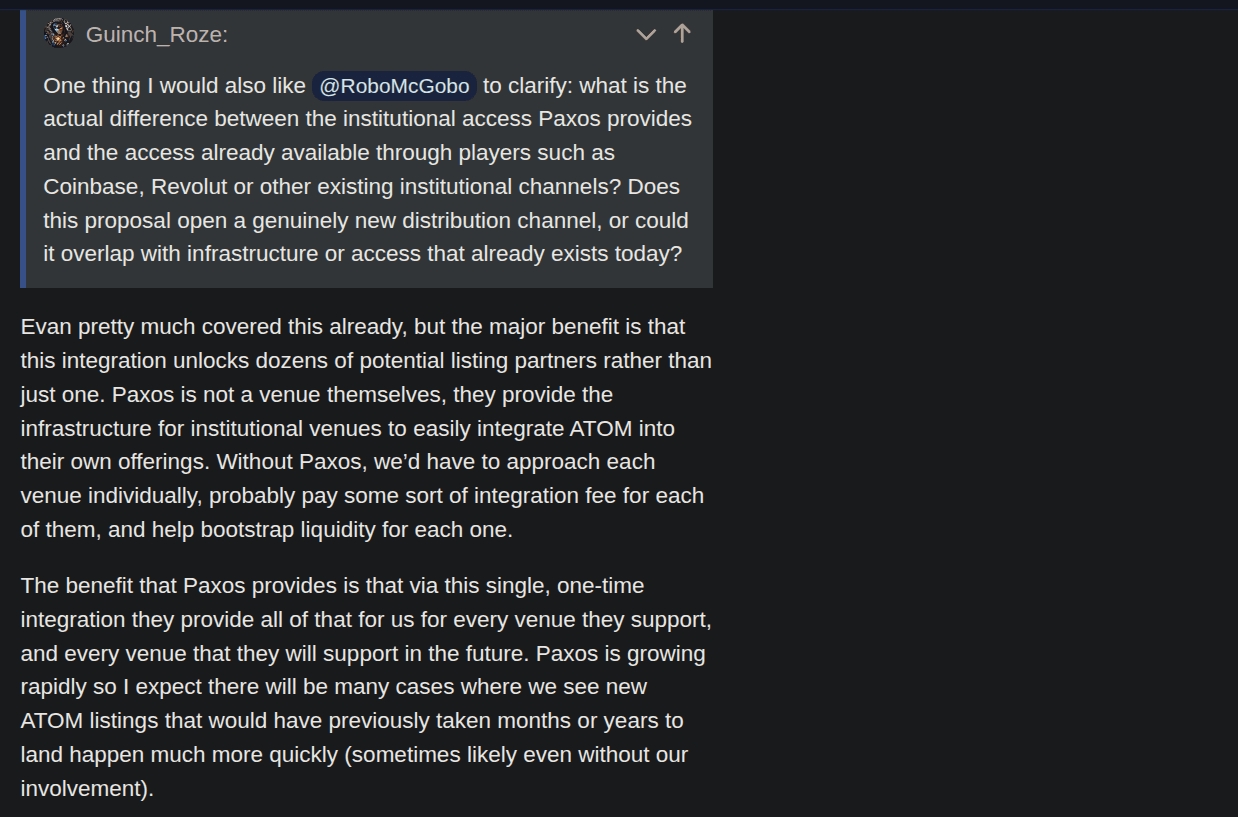
RoboMcGobo noted that ATOM is already listed on essentially every crypto-native exchange and DEX, meaning the marginal value of yet another crypto listing is close to zero, but ATOM has almost no presence on traditional brokerages, where the bulk of retail and institutional capital actually sits. Getting in now, before dozens of assets are competing for the same shelf space at firms like Schwab and Interactive Brokers, was seen as a rare first-mover opportunity.
Other supporters echoed this, adding that the permanent waiver of recurring fees signals genuine long-term alignment from Paxos rather than a one-off cash grab.
Other commenters pressed on more specific points:
How was the fee calculated? Paxos said the figure matches its standard integration fee for onboarding a new chain across its trading and custody endpoints, separate from the trade-fee-sharing terms that apply to brokerage partners.
Should disbursement be tied to milestones/KPIs? Paxos declined to gate payment on performance metrics, arguing the long-term upside for ATOM exceeds what it could otherwise offer as a conditional deal.
Does this overlap with existing institutional access via Coinbase or Revolut? Paxos and RoboMcGobo characterized Paxos as a B2B2C infrastructure layer rather than a venue itself, meaning a single integration opens the door to dozens of current and future brokerage clients, rather than one exchange relationship at a time.
Will purchased ATOM support liquidity on-chain? Paxos clarified that brokerage order flow will be routed to major trading desks and exchanges rather than the treasury funds being used to directly acquire ATOM.
Self-custody withdrawals: according to Paxos, this functionality will be available to all Brokerage Customers at launch.
After the initial wave of comments, Paxos returned with a lengthy, structured response grouping community concerns into three buckets:
Distribution
Demand, the fee structure breakdown
Adoption insights
On distribution versus real demand, Paxos leaned on scale: crypto’s total market cap is roughly $4T against $500T+ sitting on traditional venues, and as an OCC-approved national trust bank with its own trade-execution engine, it argued it serves a fundamentally different, non-crypto-native audience than Coinbase or Revolut. On the “upside” comment that had confused an earlier reader, Paxos explained it meant compounding distribution: it has the fewest brokerage clients today that it will ever have, and ATOM becomes available to every future client on day one at no extra cost. It also pointed to independent institutional traction across the Cosmos stack as evidence this momentum exists beyond the proposal itself. On comparative listings, Paxos noted tokens like RENDER (#87) are already live through partners such as CMC, that clients prioritize L1/utility tokens over memecoins, and that ATOM sat inside the Top 60 when the discussion began, while declining to share brokerage-specific volumes for confidentiality reasons.
On the fee breakdown, Paxos itemized the 300,740 USDC as covering integration engineering, OCC-related regulatory/compliance clearance, and relationship-management effort to actively pitch ATOM to brokerages, roughly 200–300 hours of work. It rejected milestone-based tranches, saying the work is already underway in good faith with product teams on standby to launch this month, and reiterated it cannot tie payment to KPIs or activation guarantees for broker-dealer legal reasons, offering quarterly listing-count reports as its accountability commitment instead.
On adoption and governance concerns, Paxos committed to sharing listing updates publicly (without client-specific flow or custody data) and gave its clearest answer yet on staking: no brokerage client will run its own validator through this integration, and if Paxos itself ever ran one, it would bring that back to the forum first. It also welcomed the idea of a community accountability channel and confirmed two changes to the proposal: quarterly public reporting on listings, and a revised go-live date of September 18th.
——————————-
In any case, this proposal confirms that the Cosmos Hub is actively following through on the strategic direction it set for itself earlier in 2026, rather than reacting opportunistically to Paxos’s outreach. Back in August, Cosmos Labs’ own internal roadmap work (following a multi-day working session in Korea) had already named turning the Hub into a bridge between traditional finance and on-chain finance as a core priority, alongside goals around performance, interoperability and enterprise-grade functionality.
The following month, that same direction materialized into the Cosmos Partner Network, a group of custody and compliance providers meant to help banks bring tokenized assets on-chain.

Interested in Staking with Us?
Join 30,000+ other stakers earning optimized rewards with our high-performance validators.
Get started and maximize your staking potential.